
About
Disclaimer
This document reflects my own personal job search findings and experiments. It is not formal research or universal guidance. It does not guarantee recruiter calls, interview invitations, responses, offers, or any other outcome in a hiring process.
Table of Contents
A Note From the Author
I built Snuky during my own job search to quickly assess how well a tailored resume matched a job description before applying.
To validate the approach, I tested ATS relevance across Ashby, Workable, Workday, Lever, and Greenhouse using Jobscan-tailored resumes with 25%, 50%, and 75% relevance scores. Resumes scoring below 49% were consistently rejected or received no response within 1-14 days. Resumes at 50% or higher had noticeably more recruiter callbacks.
Jobscan is useful, but its free plan only includes 5 resume scans per month. I wanted the freedom to scan and refine my resume whenever I needed (at least 50 times a month), without paying for every iteration and being capped on iterations, so I built Snuky.
Now I'm sharing the same resume scorer I use in my own job search for free: 25 scans per day, refreshed every morning Eastern Time.
Score Categories
Each score category evaluates a given resume using a different perspective:
-
General: Scores resumes in a general-purpose manner. It looks at the resume as a whole, checking for relevancy, skills, and keywords.
-
Keywords: Prioritizes keyword density and token weights—looking at how well the resume aligns with the job description.
-
Skills: Checks the resume for number of required skills mentioned. This is best used for roles with clear required skills listed where having the right skills matters more than how the resume is written.
-
Narrative: Focuses on language similarity between the job description and resume. This is best used when high quality summaries and tone of the resume matters more than specific keywords and skills.
Scoring Algorithms
Each category combines the following to generate its unique score:
-
TF-IDF: How similar the resume is to a job description
-
Keyword density: How frequent keywords appear in the resume and job description
-
Skills presentation: How many required skills in the job description appear on the resume
Average Score
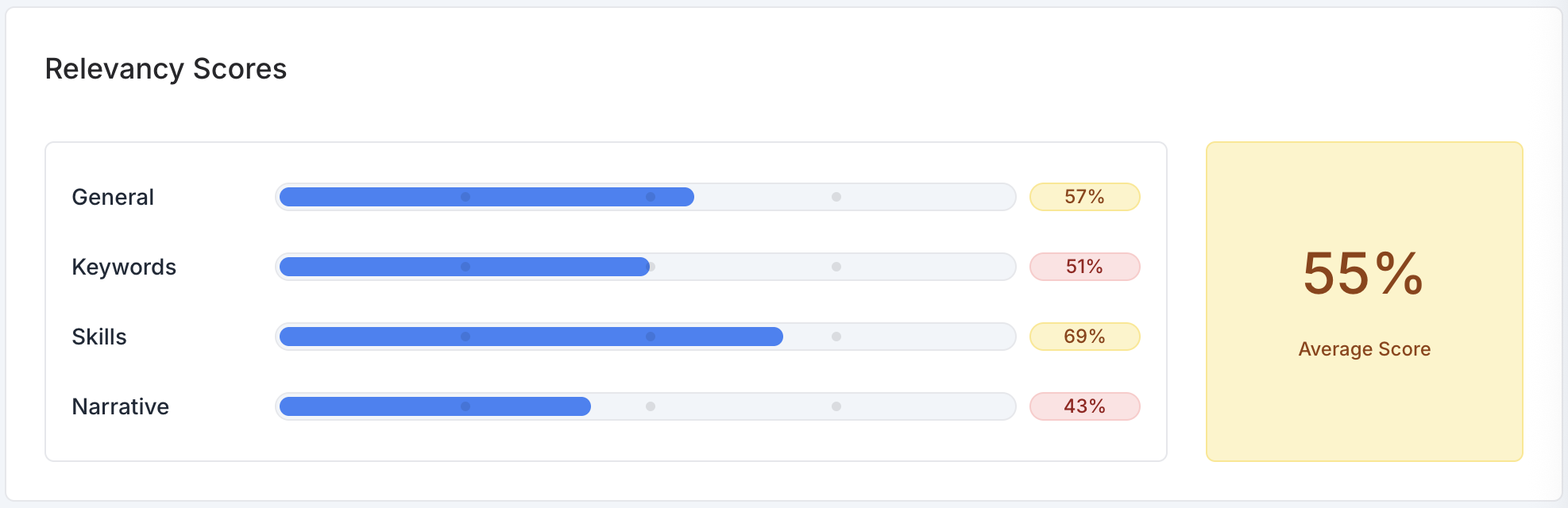
The average score combines all category scores to indicate whether a resume is "ready" overall, even if it scores lower in some categories.
For example, low keyword or narrative scores might not matter depending on the resume and target job description. In that case, this would make the resume with the below scores "ready" overall since it scores above 55% in General and Skills and has a 55% average score.
Grades
Grades are represented as perecentages and are based on the idea that anything below 55% will not get your resume seen. This is subjective to my own findings. Your findings could vary. For example, some can argue 50% is the lowest based on their data or historic data.
| Score (%) | Grade | Interpretation |
|---|---|---|
| 85-100 | Strong match | Resume closely reflects the job description |
| 70-84 | Good match | Minor gaps in language or skills |
| 55-69 | Partial match | Partial gaps worth reviewing manually |
| 0-54 | Poor match | Major gaps and misalignment (unlikely to pass automated screening) |
Submission Limits and Resets
Submission limits reset every 24-48 hours.
crookse.com